
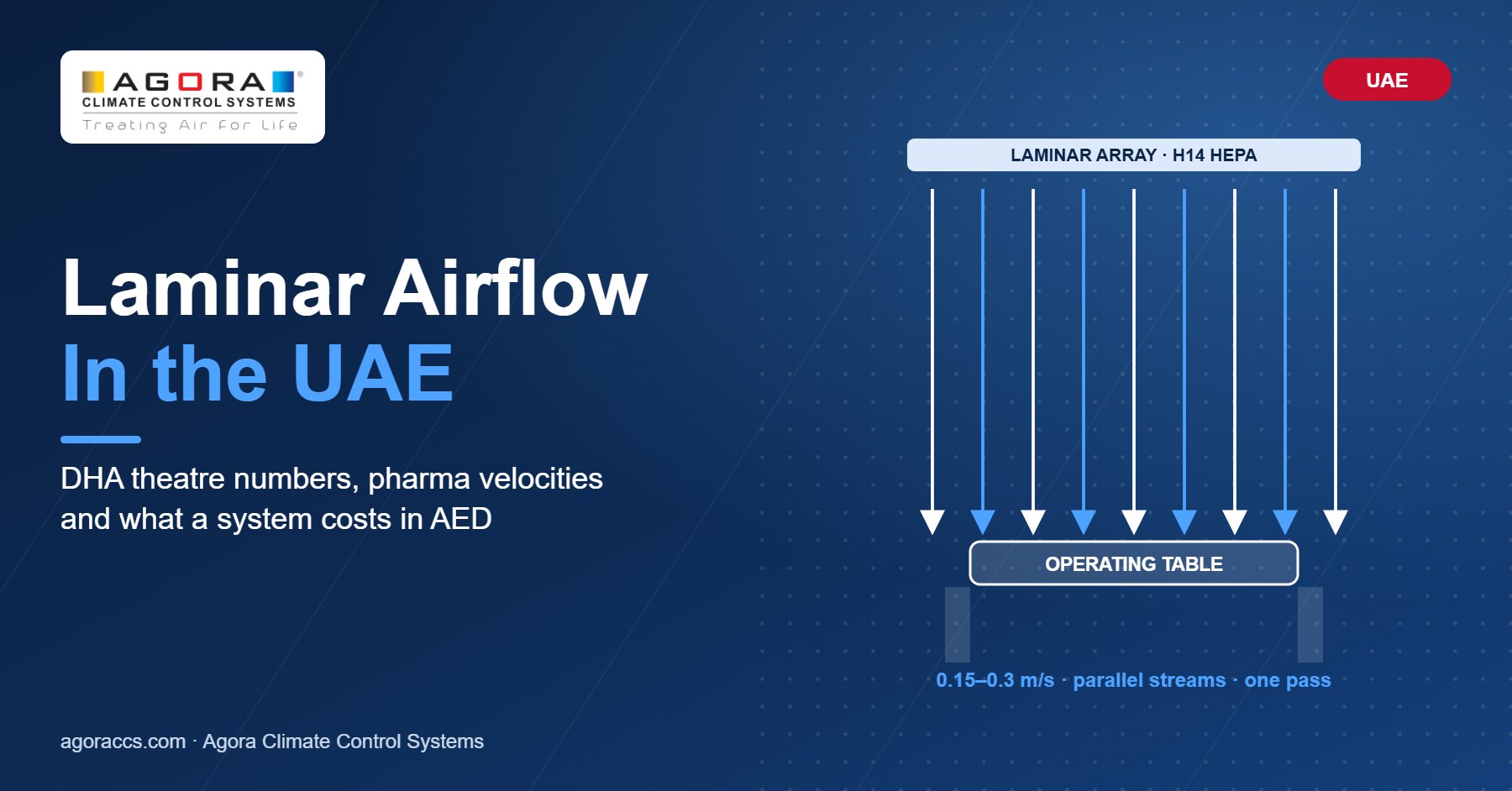
Quick answer: Laminar airflow, also called unidirectional airflow, is HEPA-filtered air that moves in parallel streams at a steady speed in one direction. As a result, the air sweeps particles out of a protected zone instead of letting them circulate. In a UAE operating room, DHA sets laminar airflow at 0.15–0.3 m/s over the table. In pharma Grade A zones and clean benches, however, it runs at 0.36–0.54 m/s.
The same two words describe a ceiling above a surgical table in Dubai and a bench-top cabinet in a Sharjah QC lab. The physics is identical, but the numbers are not. In fact, most confusion in UAE project meetings comes from mixing them up.
What laminar airflow does that normal ventilation cannot
Conventional ventilation dilutes. Clean air mixes with room air, so the average slowly improves. Laminar airflow displaces instead. The air moves like a slow piston through the zone, so a skin flake released over the wound leaves in one pass. It never comes back over the patient. Annex 1 calls air that reaches the critical surface untouched “first air”, and keeping it intact is the whole purpose.
Laminar airflow in a UAE operating theatre: the DHA numbers
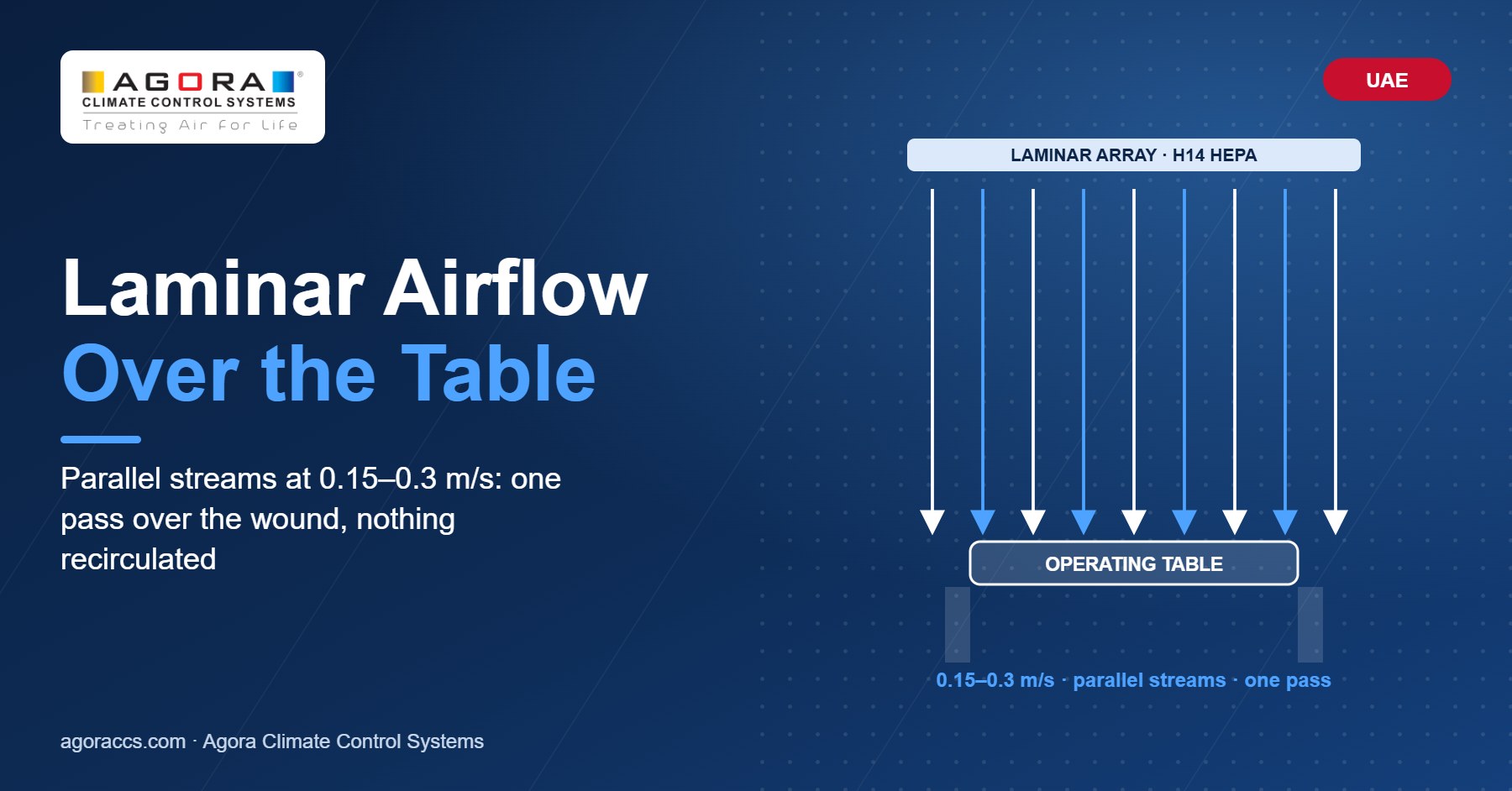
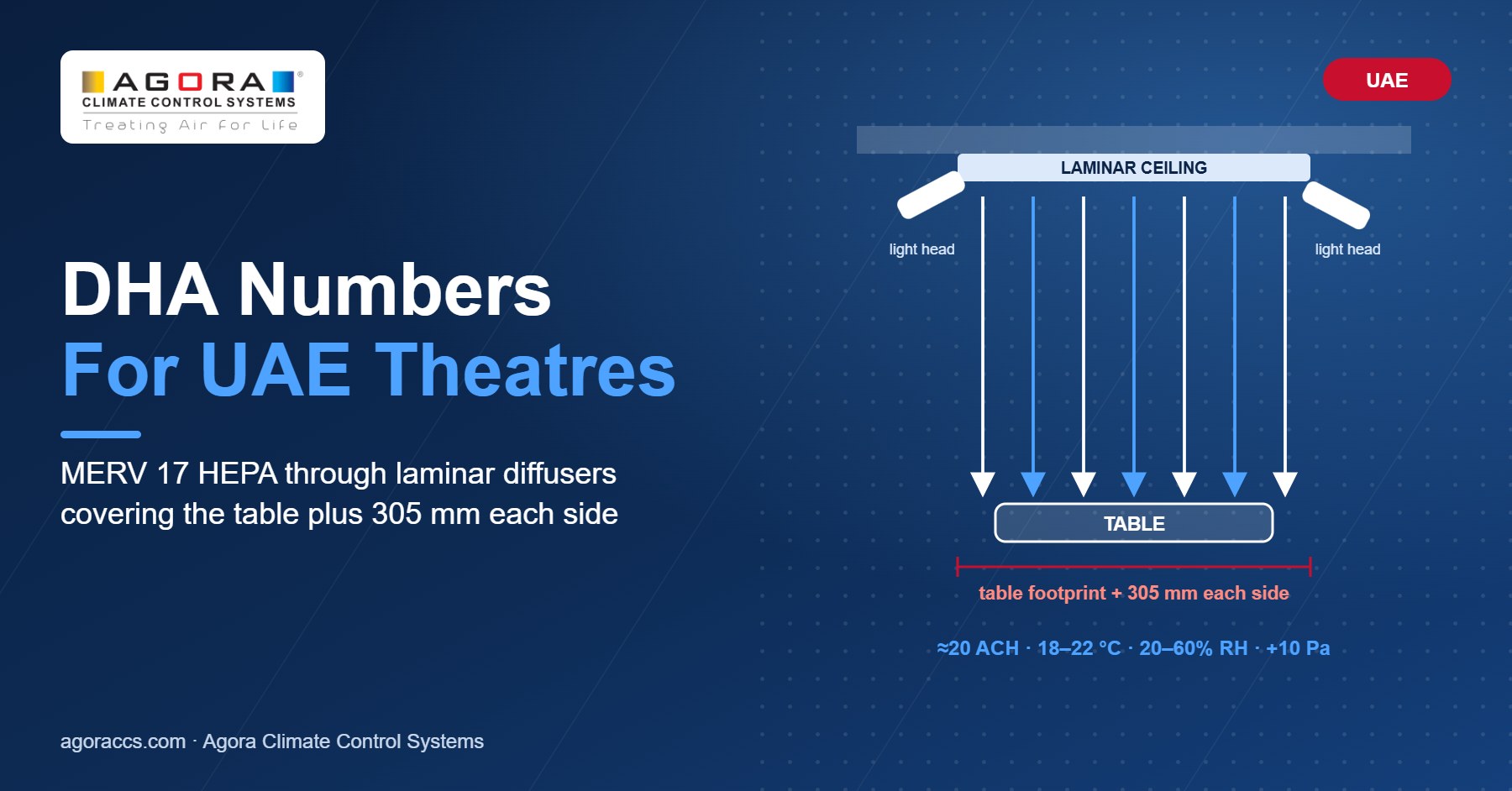
DHA’s Health Facility Guidelines Part E require HEPA-filtered air (MERV 17) through laminar airflow diffusers over the table at 0.15–0.3 m/s. The array must cover the table footprint plus 305 mm on every side. Around the column, the theatre runs at about 20 air changes per hour, 18–22 °C and 20–60% humidity. DHA also recommends +10 Pa to the corridor. The velocity is deliberately low, because at pharma speeds a surgical team would stand in a cold draught for hours. Two details then decide whether the column reaches the wound: light heads angled out of the stream, and low-level returns.
Laminar airflow in pharma, pharmacies and IVF labs
Here the protected zone is a filling needle, a vial or an embryo dish, and the operator is the main contaminant. EU GMP Annex 1, which GCC pharma plants follow, requires unidirectional flow at 0.36–0.54 m/s and ISO Class 5 air. In other words, no more than 3,520 particles of 0.5 µm or larger per cubic metre. DHA applies the same logic to hospital pharmacy cleanrooms, which need ISO 7, at least 40 air changes of HEPA air and USP 797 practice. IVF labs also get HEPA-filtered laminar airflow diffusers, plus carbon filters for VOCs. In a cabinet, the flow is either horizontal, from a rear filter toward the operator, or vertical, from a filter above the bench.
How a system goes together, ceiling or cabinet
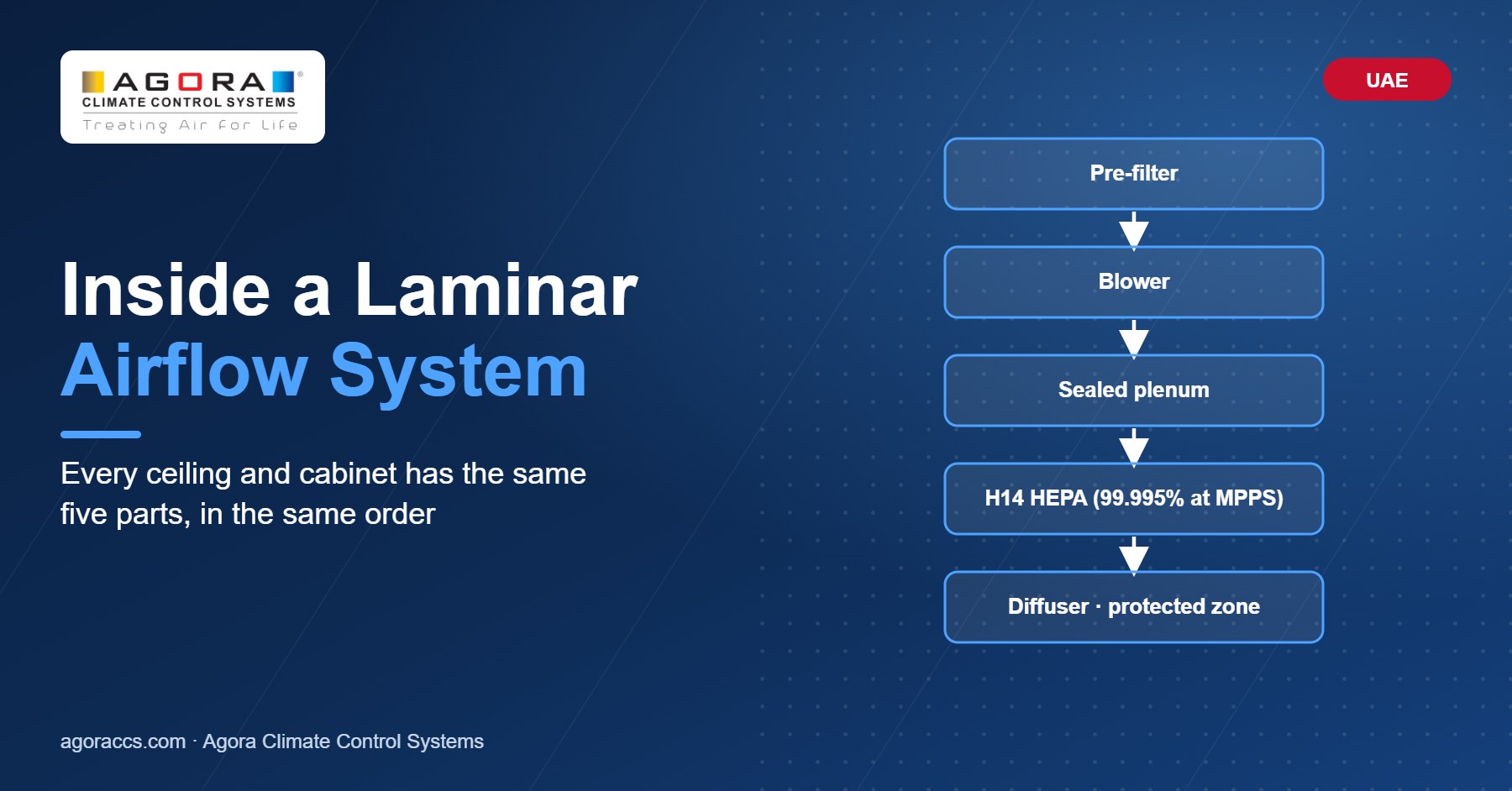
Every laminar airflow system, ceiling or cabinet, has the same parts. First come a pre-filter and a blower, then a sealed plenum that spreads pressure evenly across the HEPA face. After that sit the H14 filter, a diffuser, the protected zone and a return path. In the Gulf, sand-trap louvers and monthly pre-filter cleaning keep the velocity from sagging as the HEPA loads. Agora Climate Control Systems makes laminar airflow ceilings, cabinets and hoods near Mumbai, then ships to Jebel Ali and installs and validates in the UAE. Behind the work stand 500+ hospital projects and ISO 9001:2015. Bench-top cabinets start at about AED 1,800 ex-works for a 2 ft unit. A 6 ft vertical unit costs about AED 7,800, before freight, duty and VAT.
Frequently asked questions
What is laminar airflow?
HEPA-filtered air that moves in parallel streams at a steady velocity in one direction across a protected zone. The air displaces contamination in one pass rather than recirculating it, so engineers also call it unidirectional airflow.
What velocity should laminar airflow have?
DHA sets 0.15–0.3 m/s at the diffuser face in operating rooms, which is low enough for surgical comfort. EU GMP Annex 1, however, requires 0.36–0.54 m/s in Grade A zones and clean benches.
Is laminar airflow mandatory in UAE operating theatres?
Yes. The DHA Health Facility Guidelines require HEPA-filtered supply through laminar diffusers covering the table plus 305 mm on each side.
Does laminar airflow reduce surgical infections?
It delivers far cleaner air at the wound, which is why DHA and ASHRAE 170 specify it. Infection studies disagree, because lights in the column, open doors and crowded theatres undo the airflow. So buy it for the air class, then run the theatre properly.
How much does a laminar airflow system cost in the UAE?
Cabinets run from about AED 1,800 to AED 7,800 ex-works, depending on size, filter grade and build, before freight, duty and VAT. We price theatre ceilings per project, since the table, theatre type and air handling unit set the size.
Need a laminar airflow design for a theatre, lab or plant in the UAE?
Tell us the zone to protect and the class to prove. We then reply within one working day with a design, a velocity target and an itemised AED quote. WhatsApp +91 93232 98094 or request a free consultation at agoraccs.com/contact.