
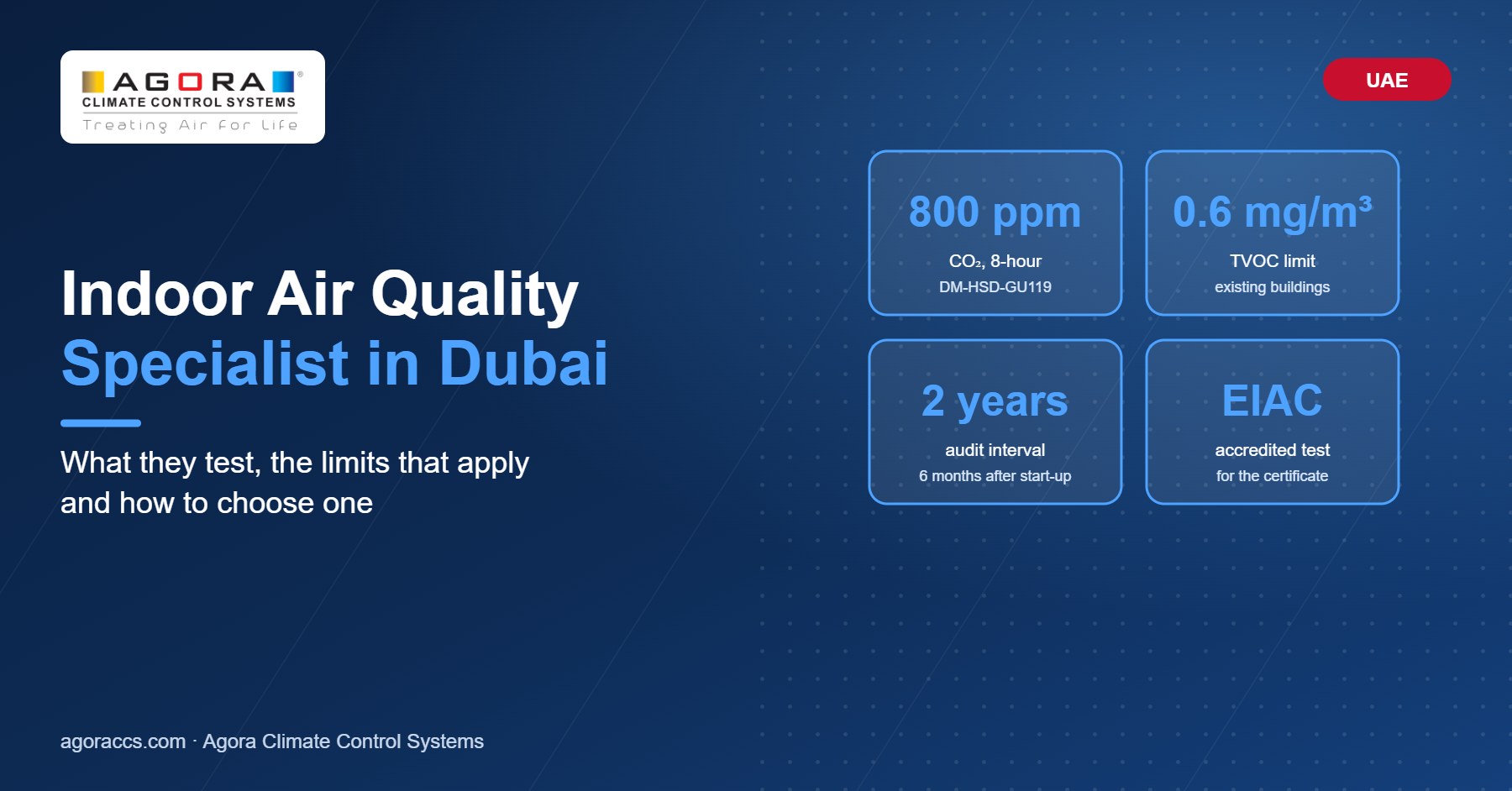
Quick answer: An indoor air quality specialist tests a building’s air for CO₂, particles, TVOC, formaldehyde, microbes, temperature and humidity. The tests follow the averaging times in Dubai Municipality’s guideline DM-HSD-GU119, and the specialist then fixes the ventilation, filtration or moisture problem behind any failure. In Dubai, only an EIAC-accredited company can run the compliance test. An indoor air quality specialist with HVAC capability, however, is the one who makes the building pass.
Dubai buildings are sealed, air-conditioned most of the year and fed outdoor air full of dust. As a result, you get the sick-building complaints Dubai Municipality set out to curb: headaches, dry eyes and afternoon drowsiness. An indoor air quality specialist turns those complaints into numbers, and then the numbers into a fix.
What an indoor air quality specialist tests, and the Dubai limits
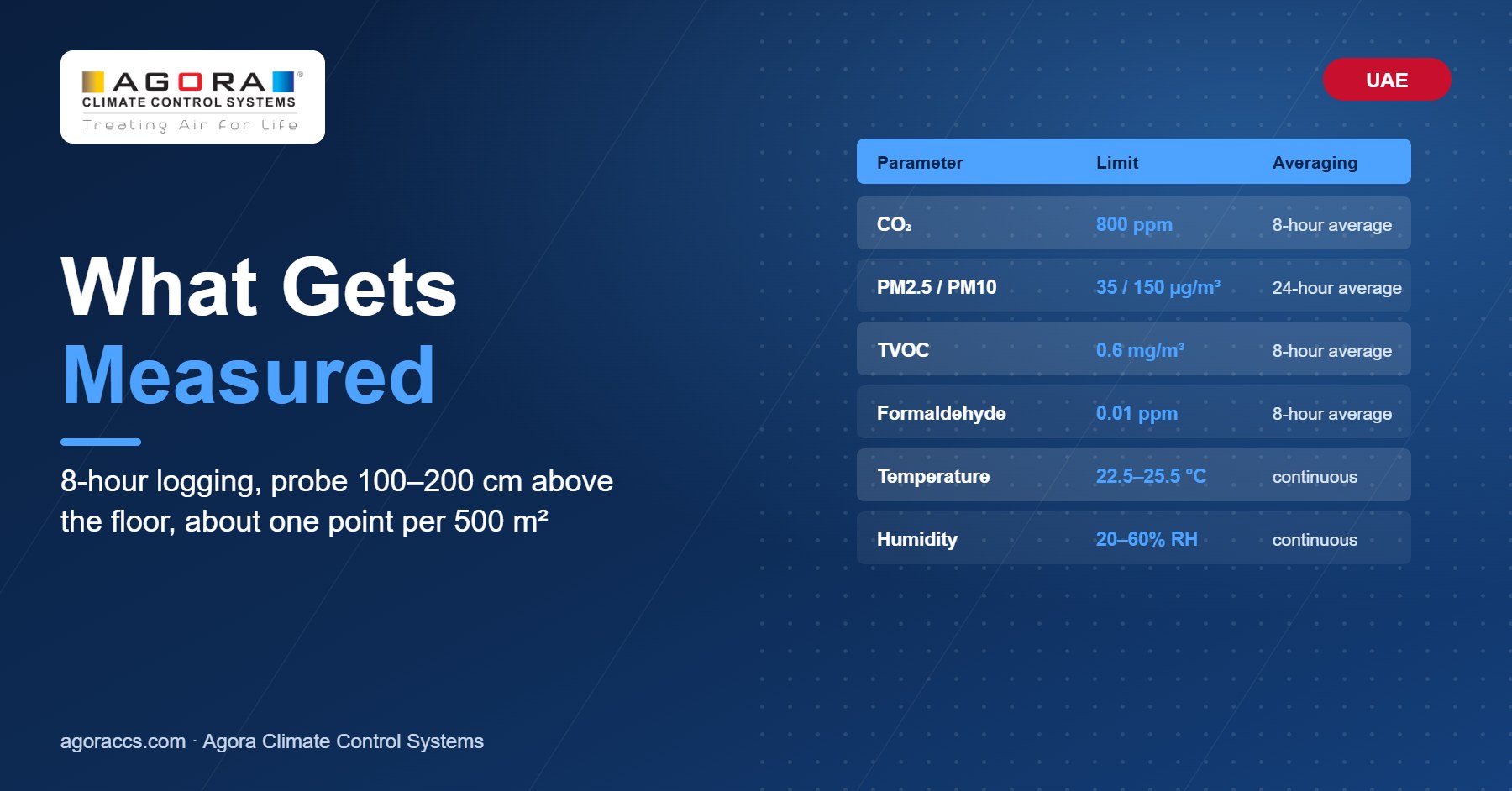
For existing buildings, the guideline sets CO₂ at 800 ppm over 8 hours. Meanwhile, PM2.5 sits at 35 µg/m³ and PM10 at 150 µg/m³ over 24 hours. TVOC is 0.6 mg/m³, formaldehyde is 0.01 ppm over 8 hours, and bacteria and fungi are 1,000 and 500 CFU/m³. New buildings other than villas also take a pre-occupancy test under the Dubai Building Code: formaldehyde below 0.08 ppm, TVOC below 300 µg/m³ and PM10 below 150 µg/m³. Sampling runs for 8 hours, with the probe 100–200 cm above the floor and about one point per 500 m². That is why a good specialist logs continuously rather than spot-checking. CO₂ peaks at 3 pm, for example, while humidity peaks at dawn.
The problems an indoor air quality specialist finds most often in the UAE
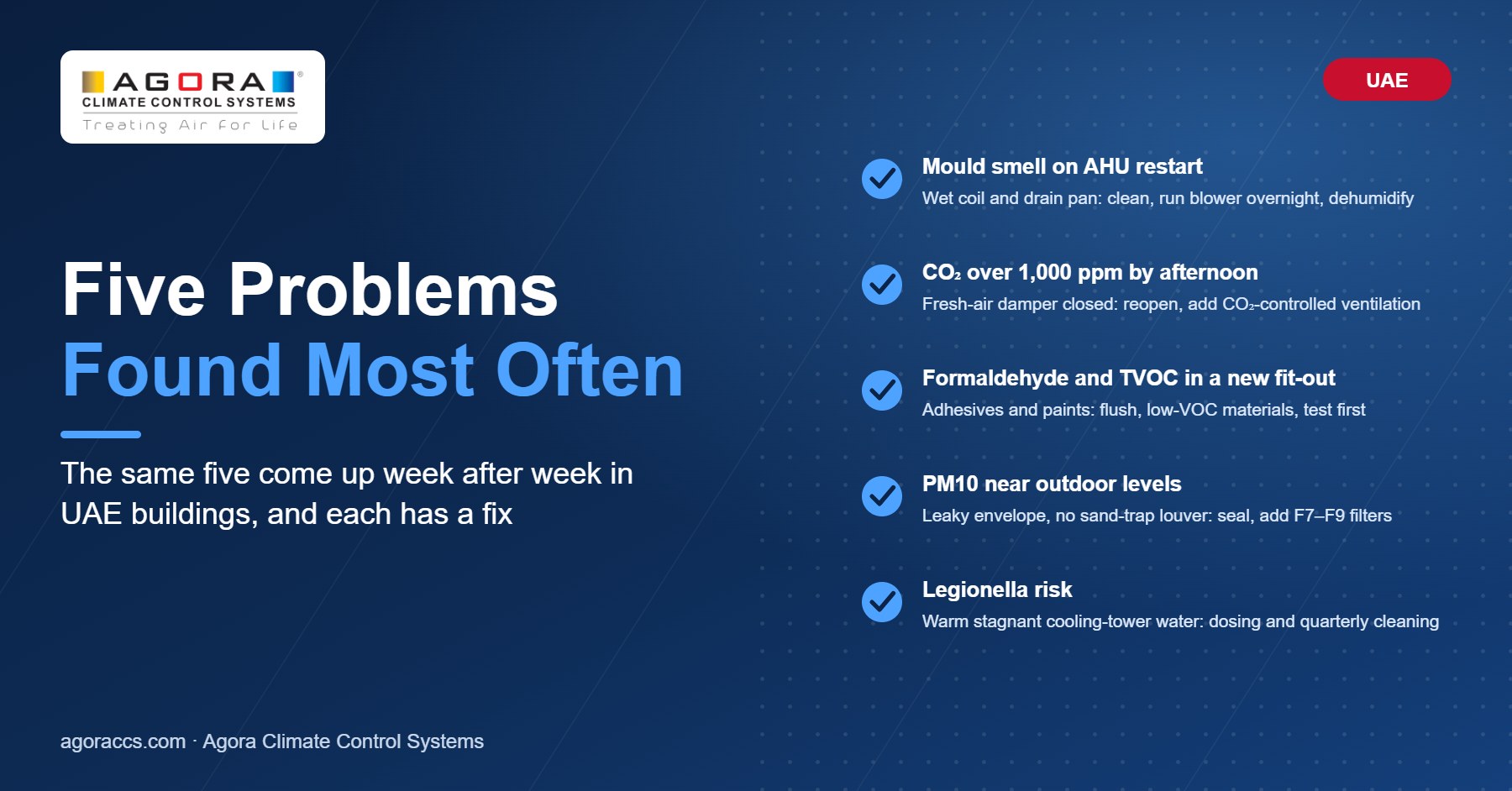
Here, the same five come up week after week:
- Mould smell when the AHU restarts: a wet coil and drain pan. So clean the coil, run the blower overnight on a VFD and add dehumidification.
- CO₂ over 1,000 ppm by afternoon: a fresh-air damper closed to save cooling. Reopen it, then add CO₂-controlled ventilation with heat recovery.
- Formaldehyde and TVOC high in a new fit-out: adhesives, laminates and paints. Flush with outdoor air, use low-VOC materials and test before the certificate.
- PM10 near outdoor levels: a leaky envelope, no sand-trap louver, or an intake near a road or generator. Seal the envelope, add F7–F9 fresh-air filters and move the intake.
- Legionella risk: warm, stagnant cooling-tower water. Dosing, quarterly cleaning and automatic basin cleaning solve it.
Hospitals, labs and pharma: a different brief for the indoor air quality specialist
The Dubai Municipality guideline excludes medical and industrial buildings. In a hospital, the work instead follows DHA’s Health Facility Guidelines and ASHRAE 170. Operating rooms need about 20 HEPA-filtered air changes and +10 Pa, while isolation rooms need 12 air changes and negative pressure. Pharmacy cleanrooms also need ISO 7. WHO puts hospital-acquired infection at 7 of every 100 acute-care patients in high-income countries, so these rooms get tests at rest and in operation.
How to choose one in Dubai: five questions to ask
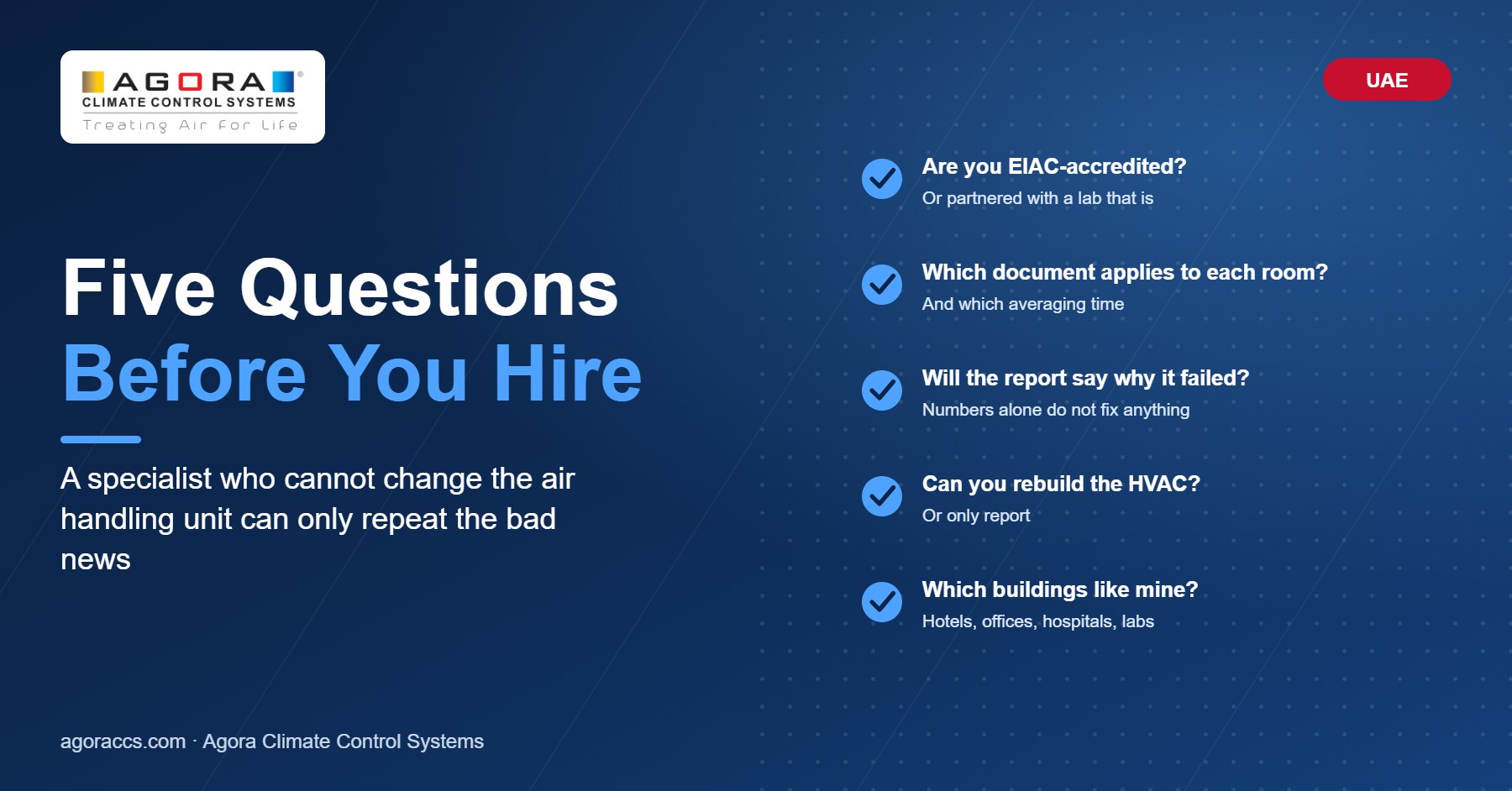
Ask the indoor air quality specialist these questions. Are you EIAC-accredited, or partnered with a lab that is? Then, which document and averaging time applies to each room? Also, will the report say why a reading failed? Can your firm rebuild the HVAC, or only report? Finally, which buildings like mine have you handled? An indoor air quality specialist who cannot change the air handling unit can only repeat the bad news. Agora Climate Control Systems answers the last two with 16 years of hospital and cleanroom HVAC, 500+ projects and ISO 9001:2015. In addition, our engineers travel to UAE sites, and we work with accredited lab partners.
Frequently asked questions
What does an indoor air quality specialist do?
Tests a building’s air for particles, gases, microbes and humidity against the limits for that space. The specialist then finds the cause of any failure and corrects ventilation, filtration or moisture control so the building passes.
What is the Dubai Municipality CO₂ limit?
Specifically, 800 ppm as an 8-hour average in existing buildings. Al Sa’fat also requires demand-controlled ventilation set below 800 ppm, with an alarm above 1,000 ppm.
How often should indoor air get a test in Dubai?
The guideline recommends an audit within six months of HVAC start-up, then every two years, and hotels must. Hospitals instead validate theatres and cleanrooms on DHA and ISO 14644 schedules.
Can an indoor air quality specialist issue the Dubai Municipality certificate?
Only through a company or laboratory accredited by EIAC, with calibrated instruments and results filed with the municipality. Monitoring prepares you for that test, but it does not replace it.
Does the Dubai guideline apply to hospitals?
No. It covers hotels, offices, malls, schools and homes, not the medical and industrial sectors. Hospitals follow DHA requirements instead, and their specialist works to ASHRAE 170.
Need an indoor air quality specialist for a building, lab or hospital in the UAE?
Tell us the rooms, the regulator and what you have noticed. Our indoor air quality specialist then sends a test plan and an AED quote within two working days. WhatsApp +91 93232 98094 or request a free consultation at agoraccs.com/contact.