
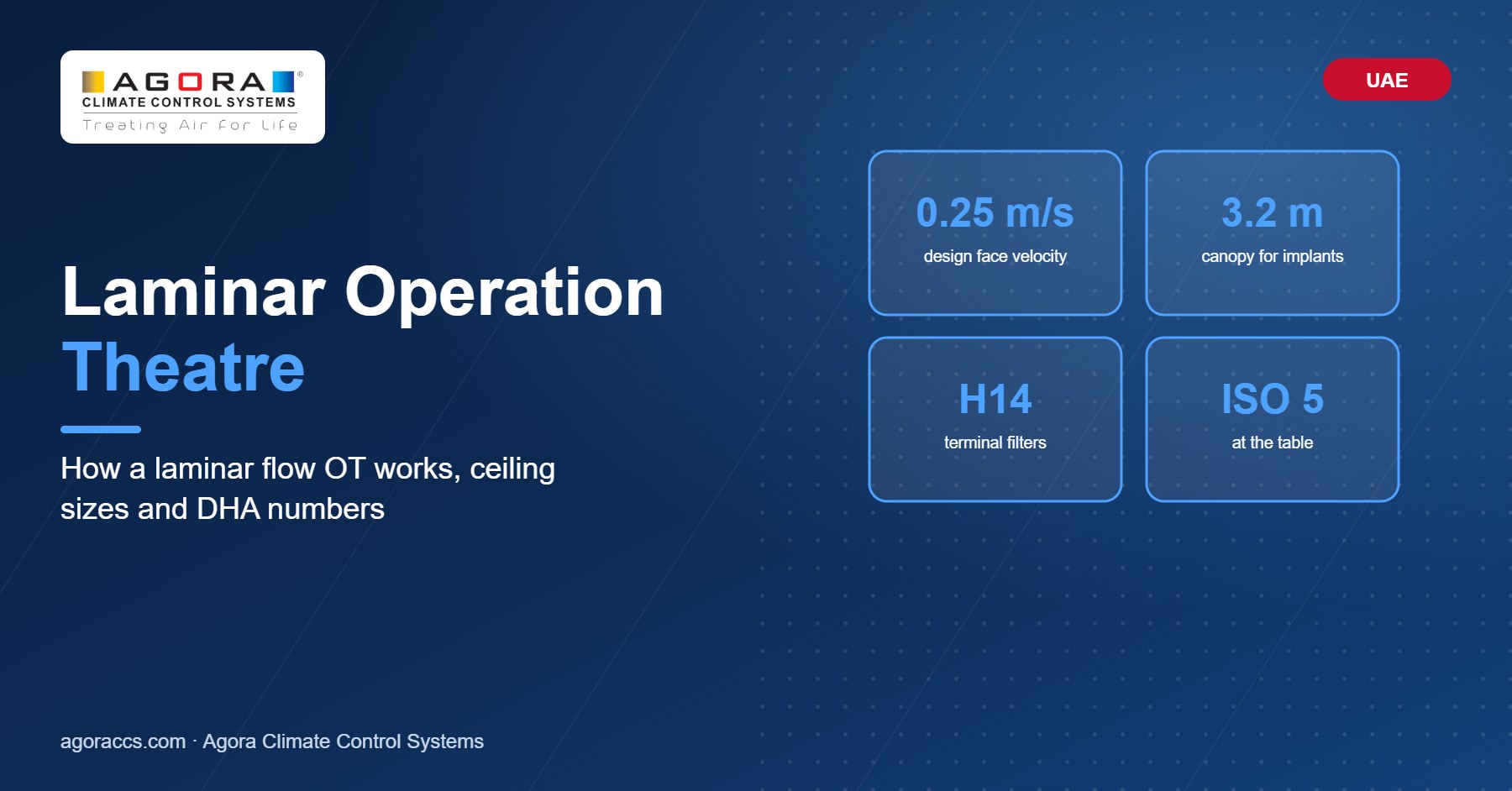
Quick answer: A laminar operation theatre pushes HEPA-filtered air straight down over the table at 0.15 to 0.3 m/s. The air moves like a piston, carries particles away from the wound and leaves through low corner grilles. In the UAE, DHA wants the canopy to cover the table plus 305 mm on each side. It also wants H14 filters at the terminals and about 20 air changes per hour. A laminar operation theatre therefore comes down to three numbers: canopy size, face velocity and filter grade.
Every modern theatre in Dubai or Abu Dhabi has a laminar ceiling. Yet few people can say what it does or how big it should be. So this guide explains the laminar operation theatre from filter face to floor grille.
What a laminar operation theatre does
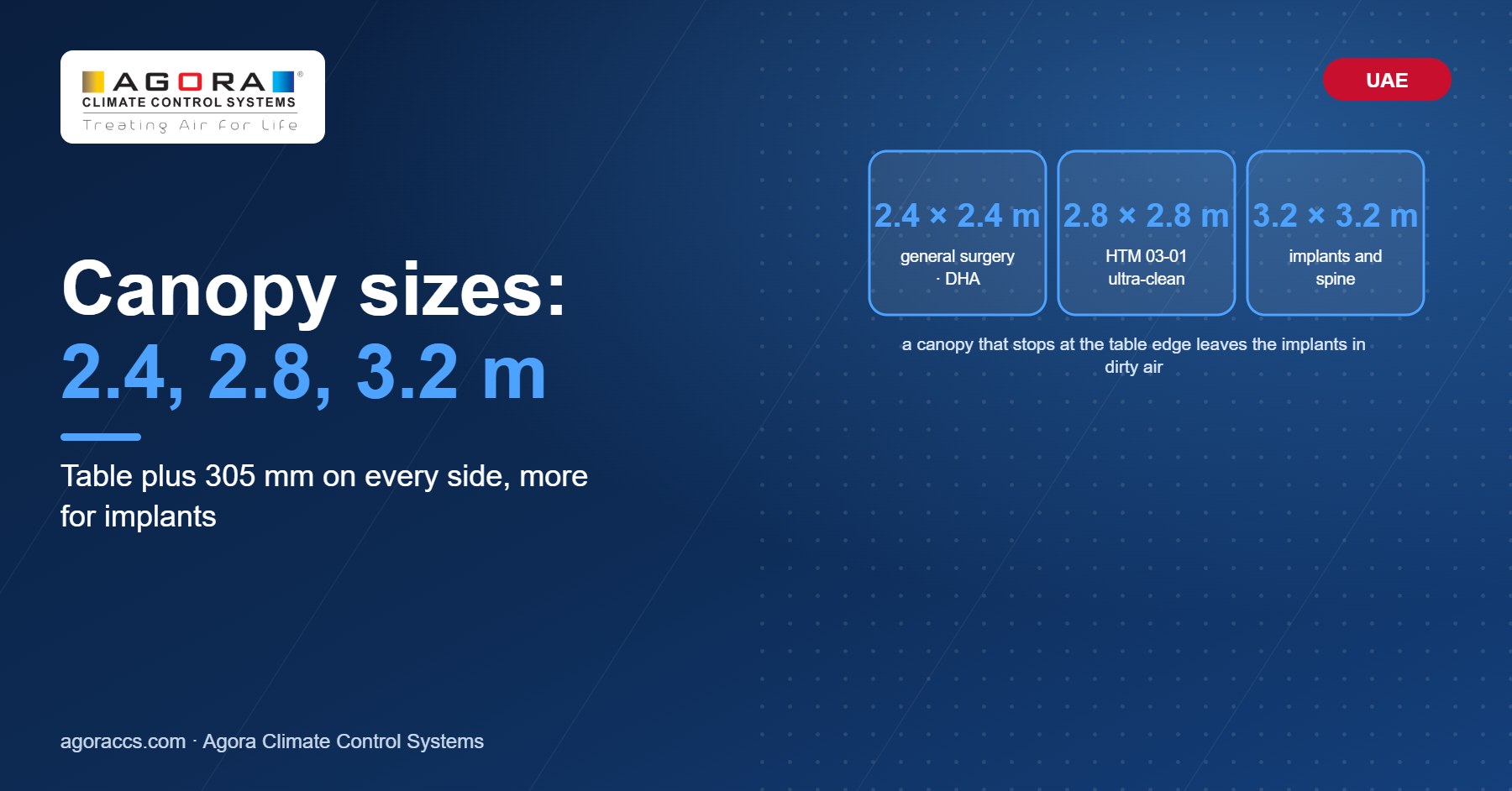
Normal air conditioning mixes supply air with room air, so particles float everywhere. A canopy of H14 filters above the table delivers air in parallel streams at a steady speed. Because the streams move together, they carry particles shed by the team down and outward, away from the wound. A laminar operation theatre thus keeps the surgical zone at ISO 5 while the room sits at ISO 7.
Canopy sizes: 2.4, 2.8 and 3.2 metres
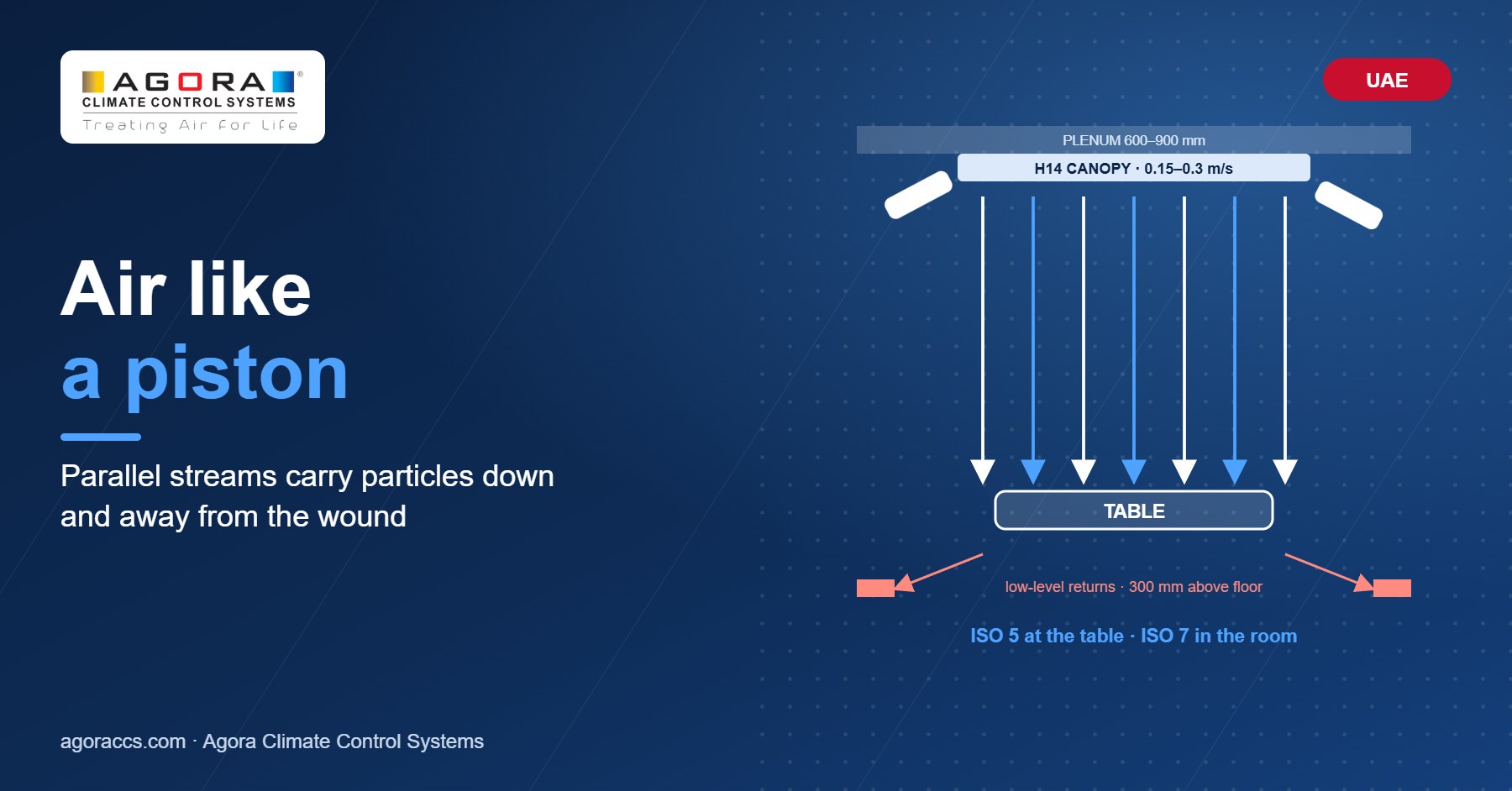
The canopy must cover the table plus 305 mm on every side under DHA rules. For general surgery, 2.4 × 2.4 m does that. The UK’s HTM 03-01 asks for at least 2.8 × 2.8 m for an ultra-clean canopy. For implants and spine work, we recommend 3.2 × 3.2 m, so the instrument trolleys sit inside the clean zone. In a laminar operation theatre, a canopy that stops at the table edge leaves the implants in dirty air.
Velocity, volume and the recirculation question
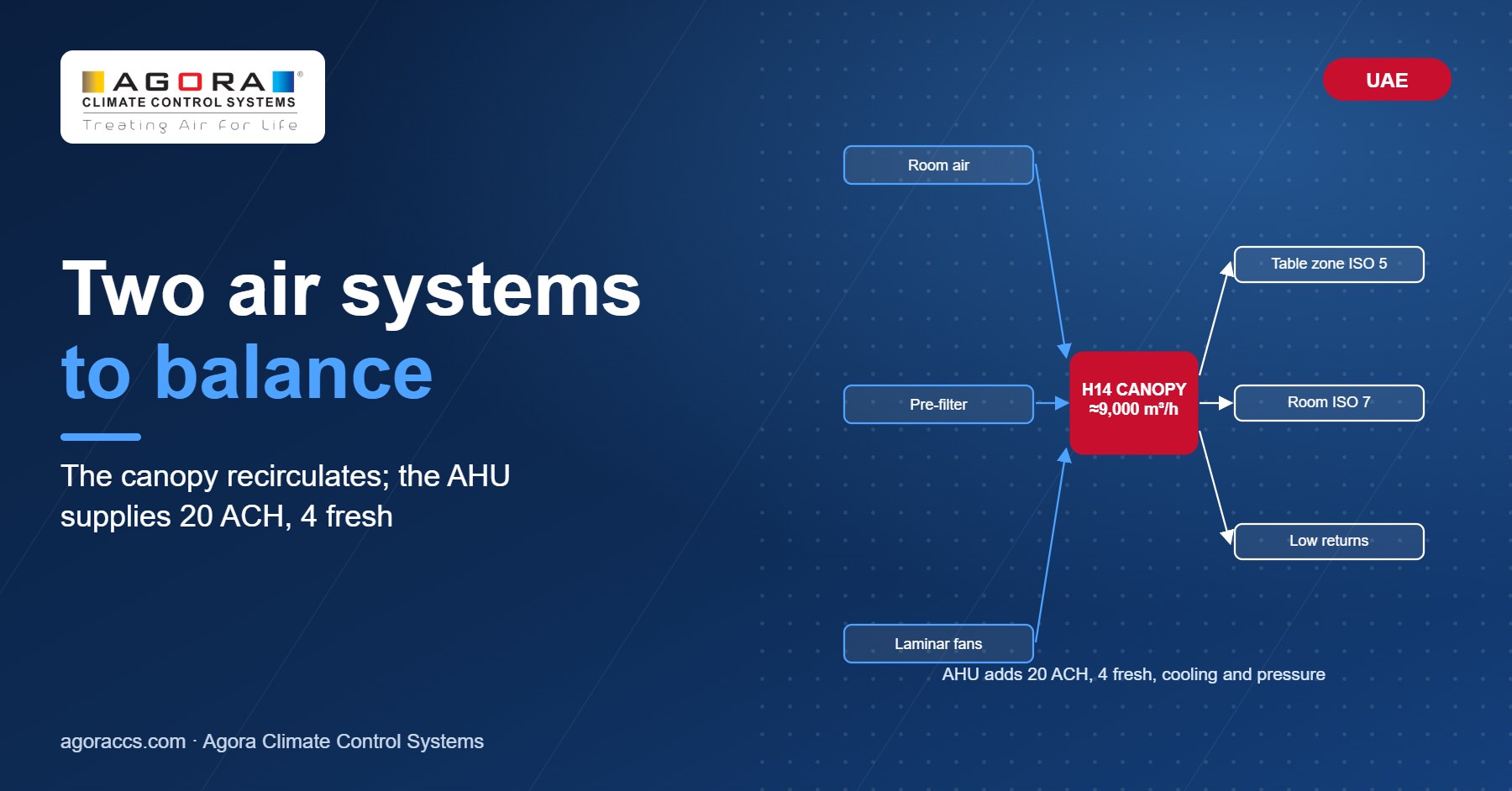
Face velocity sits between 0.15 and 0.3 m/s; we usually design at 0.25 m/s. Multiply by the canopy area and the volume grows fast. A 3.2 m canopy moves about 9,000 m³/h, more than 70 air changes in a 42 m² room. So the canopy cannot run on fresh air alone. Instead, the laminar unit recirculates room air through its own fans and H14 filters. Meanwhile, the AHU supplies the 20 air changes, four of them fresh. In other words, a laminar operation theatre has two air systems to balance together.
DHA numbers for a laminar operation theatre
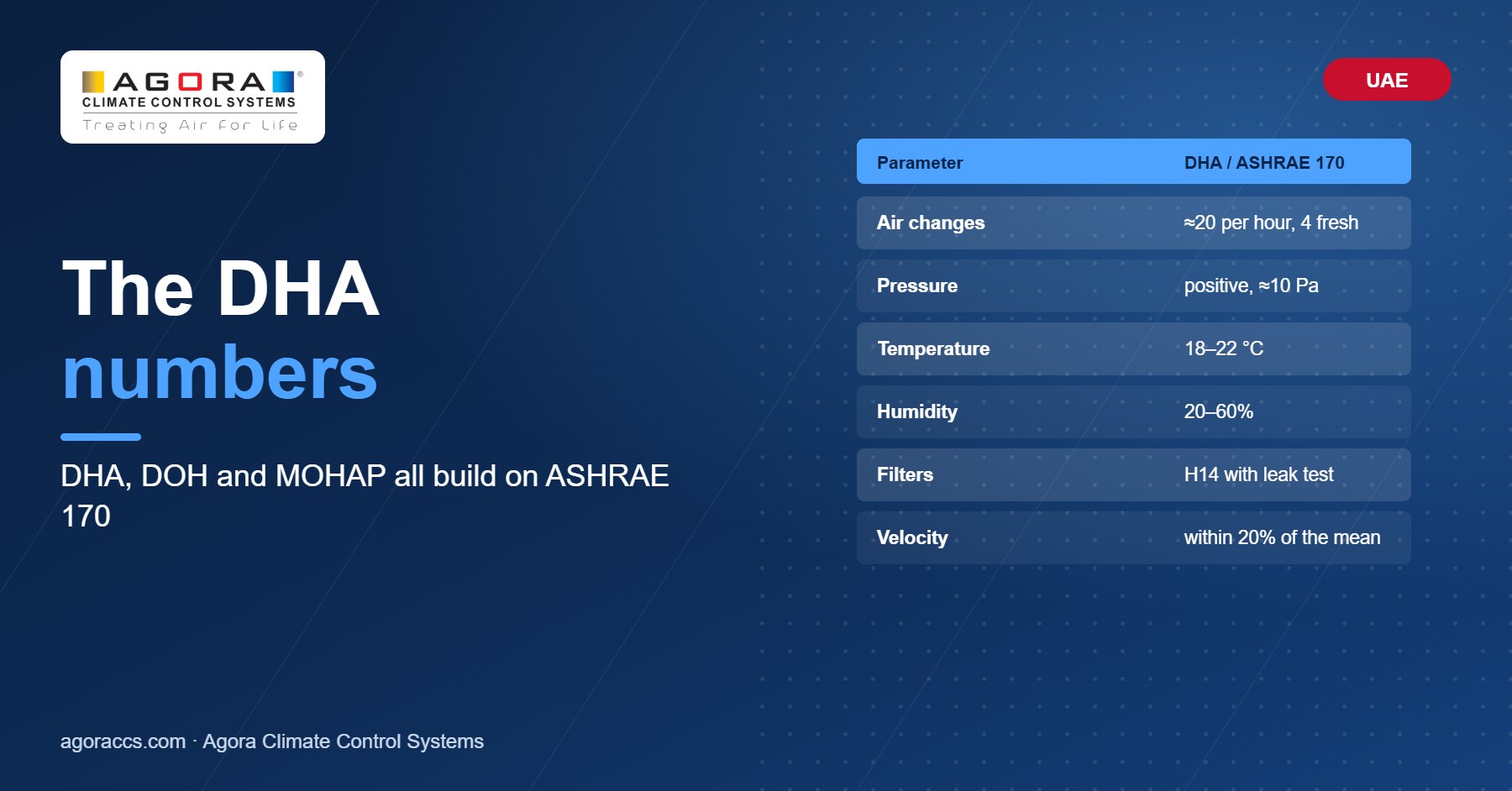
DHA Health Facility Guidelines, DOH Abu Dhabi and MOHAP all build on ASHRAE 170. The room needs about 20 air changes per hour, four fresh, and positive pressure near 10 Pa. Temperature sits at 18 to 22 °C and humidity at 20 to 60%. At the canopy, filters must be H14 with a leak test. Velocity must also stay within 20% of the mean across the face. We test our laminar airflow units and HEPA modules against those figures before they ship. The ceiling layout follows our modular operation theatre design guide.
Testing and maintenance
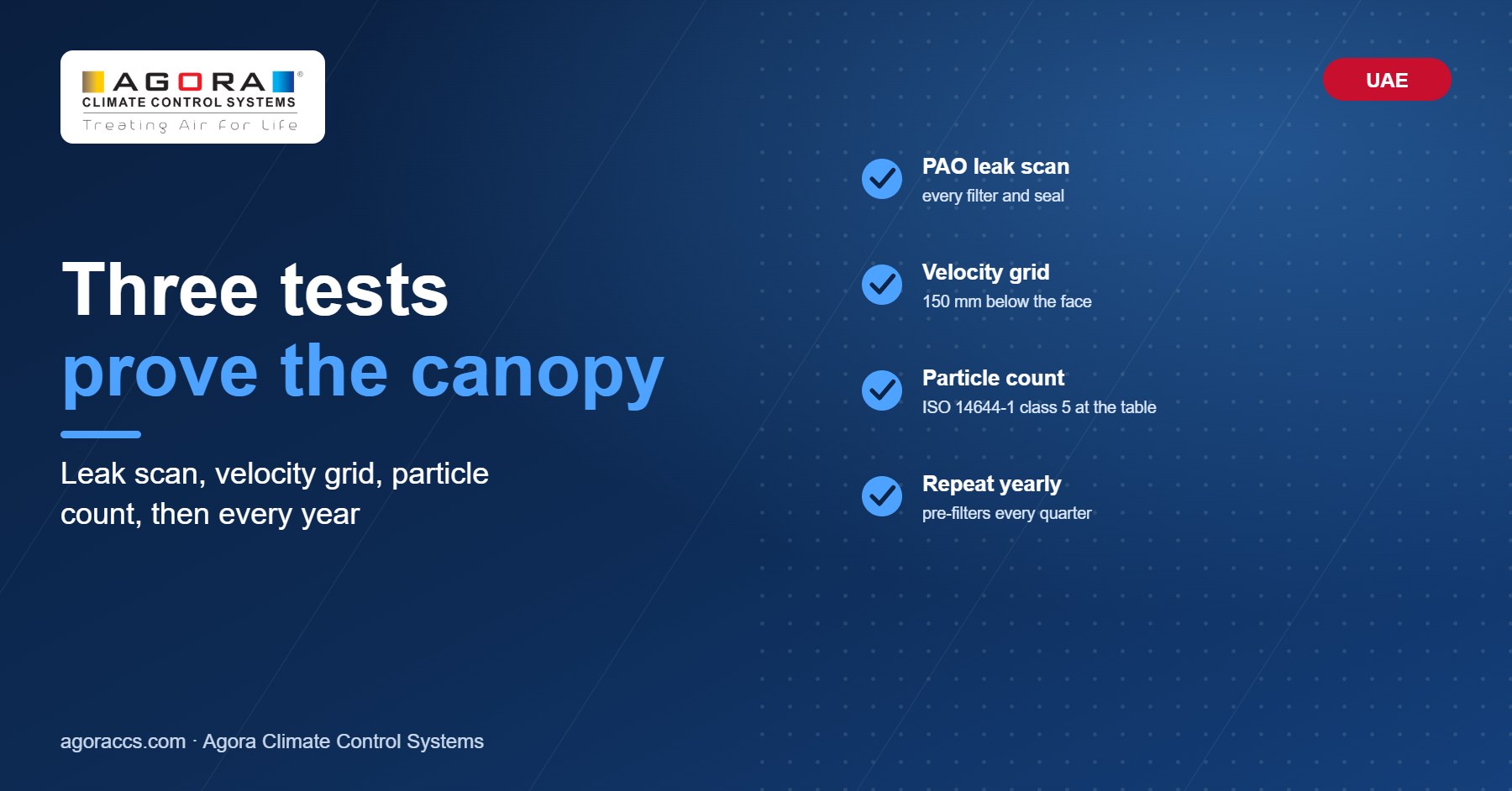
Three tests prove the canopy. First, a PAO leak scan of every filter and seal. Second, a velocity grid at 150 mm below the face. Third, a particle count at the table to ISO 14644-1 class 5. Then repeat them every year, and change the pre-filters every quarter. H14 filters usually last two to three years in the UAE, since dust loads the pre-filters first. Studies disagree on infection rates. So we design the canopy for particle control and still insist on the rest of the infection-control bundle. Our OT validation team documents all three tests for the DHA file.
Frequently asked questions
What is a laminar operation theatre?
A theatre whose H14 ceiling canopy pushes clean air straight down over the table at 0.15 to 0.3 m/s, so particles move away from the wound.
How big should the canopy be?
Table plus 305 mm on each side under DHA rules. That means 2.4 × 2.4 m for general work and 3.2 × 3.2 m for implants.
Does a laminar operation theatre still need an AHU?
Yes. The canopy recirculates room air through its filters, while the AHU supplies the air changes, fresh air, cooling and pressure.
What velocity is correct in a laminar operation theatre?
Between 0.15 and 0.3 m/s at the filter face, within 20% of the mean. Most designs use 0.25 m/s.
How often does a laminar operation theatre need testing?
At handover and then every year: leak scan, velocity grid and particle count. Pre-filters change every quarter.
Planning a laminar operation theatre in the UAE?
Send us the room size and the specialty. We then return the canopy size, the air balance and an itemised AED quote within two working days. WhatsApp +91 93232 98094 or request a free consultation at agoraccs.com/contact.