
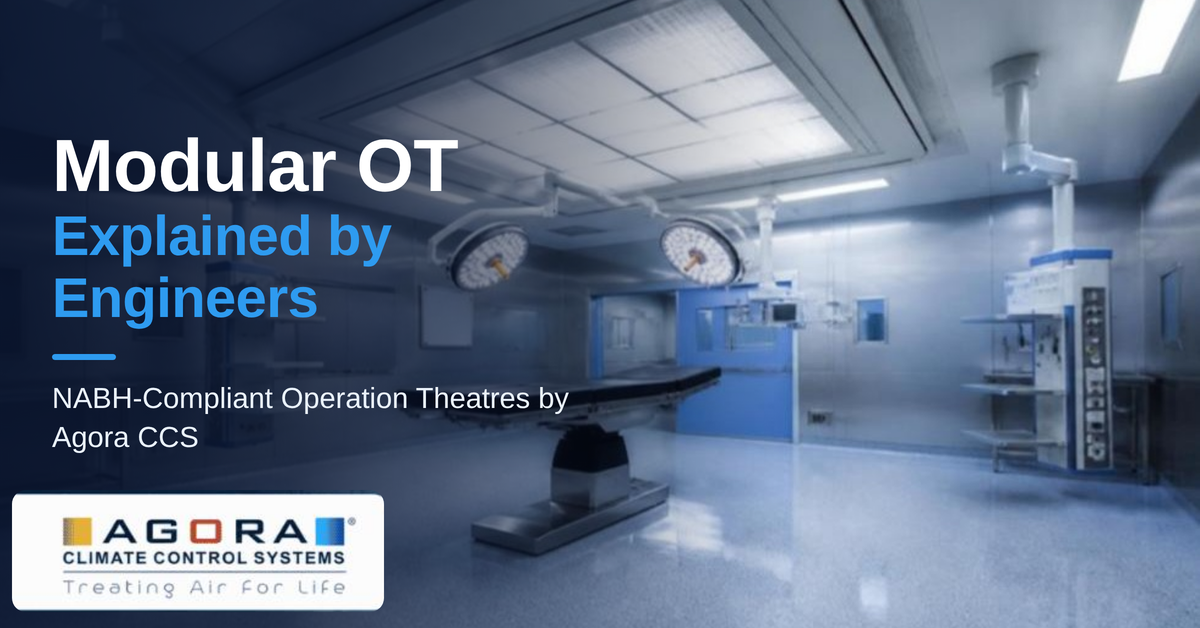
What Is a Modular OT and Why Does It Matter?
A modular OT is a surgical room built from factory-made panels and a fully integrated air system. However, vendors use the phrase loosely. Some mean an engineered room; others mean panels bolted around an old split AC.
That difference shows up later — in your particle counts, your NABH assessment and your infection committee minutes. So here is what actually matters, from engineers who build these rooms.
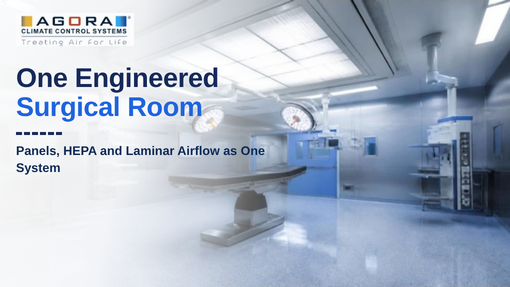
Inside a Modular OT: What You Get
In a modular operation theatre, the envelope and the air system are designed, manufactured and tested as one product. The walls are pre-finished panels, typically 50 mm thick, with steel, SS 304 or HPL skins. Panels lock together with coved corners. As a result, there is no plaster to crack and no corner a mop cannot reach.
A conventional theatre is masonry and plaster, with HVAC added by a separate contractor. In fact, that is the core difference. A modular OT behaves as one engineered system. Because of that, it reaches NABH air standards faster and holds them for years. That means fewer audit findings and lower running costs, year after year.
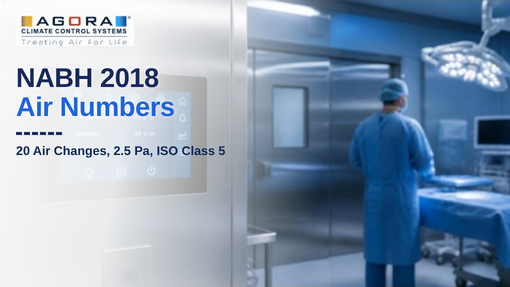
NABH 2018 Numbers Every Modular OT Must Hit
NABH assesses the air, not the panels, so these are the numbers every theatre must hold around the clock.
- 20 air changes per hour — the minimum, with at least 4 of them fresh air, for both Type A and Type B theatres.
- HEPA at 99.97% efficiency — measured at 0.3 µm; Type A theatres need terminal H14 filters (99.995% at MPPS).
- Positive pressure of 2.5 Pa — held 24 hours a day, so air always leaves the room and never enters.
- ISO Class 5 at the grille — for Type A super-specialty theatres at rest; Type B general theatres need ISO Class 6.
- Airflow at 25–35 feet per minute — unidirectional and downward, extending at least a foot beyond the table on all four sides.
The full air-performance table is published in the NABH revised guidelines for operation theatre air conditioning.
Because the specification drives the price, insist on quotes that state these numbers. We compare build methods in modular OT vs traditional OT construction. Our guide to modular OT cost in India breaks down budgets. After handover, our OT validation services cover the six-monthly cycle.
Why Hospitals Trust Agora CCS
Agora Climate Control Systems has built modular operation theatres, ICUs, IVF labs and cleanrooms for over 16 years. We manufacture our own laminar airflow and DXAHU units at our Vasai factory near Mumbai. So far, we have delivered more than 500 hospital projects across India, Southeast Asia and Africa. We hold ISO 9001:2015 and design to NABH, ASHRAE 170 and DIN 1946-4. Lilavati, Fortis and KIMS are among our clients.
Visit: https://agoraccs.com/ | Free Consultation | Pan India Delivery
Frequently Asked Questions (FAQ)
Q1. How much does a modular OT cost in India?
There is no fixed price. Cost depends on theatre type (Type A or B), size, HEPA grade, AHU capacity, panel material, doors and site conditions. For example, a Type A cardiac theatre costs far more than a Type B general theatre. Always ask for an itemised quote stating ISO class and air changes.
Q2. Is a modular operation theatre mandatory for NABH accreditation?
No. The NABH 2018 guideline states it is not mandatory under any programme. NABH assesses the air instead: 20 air changes per hour (4 fresh), 2.5 Pa positive pressure and HEPA filtration. However, a factory-built theatre is the most reliable way to meet those numbers.
Q3. How long does a modular operation theatre take to install?
Typically 45 to 75 days from design approval to commissioning, depending on size and complexity. Panels are fabricated in the factory while site preparation runs in parallel, so the on-site phase stays short. Validation and documentation are part of that window, not an extra step after it.
Q4. What ISO class should an operation theatre be?
Under NABH 2018, a Type A theatre needs Class 100 / ISO Class 5 at the grille at rest. A Type B general theatre needs Class 1,000 / ISO Class 6. For reference, ISO 14644-1 defines Class 5 as under 3,520 particles of 0.5 µm per cubic metre.