How to Choose the Right HEPA Filter for OT Use
A HEPA filter for OT use is the final barrier between the air handling unit and the patient’s open wound. Its grade, placement and test history decide whether your theatre is clean on paper or clean at the table.
However, we still find untested filters and leaking frames on site. So here is what biomedical engineers, OT in-charges and quality teams actually need to know.
What Does a HEPA Filter for OT Actually Do?
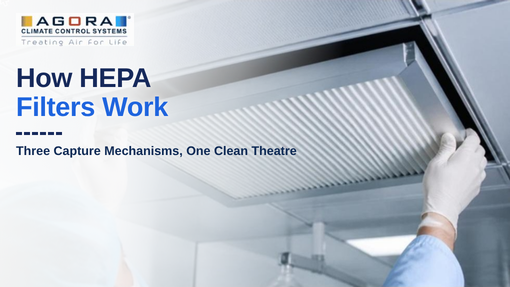
A HEPA filter is a pleated mat of fine glass-fibre media. It traps large particles by impaction, mid-sized ones by interception and the smallest by diffusion. The hardest particle to catch sits around 0.1–0.3 µm, the most penetrating particle size (MPPS). That is why filters are rated there.
In practice, a HEPA filter for OT supply air removes skin squames (5–60 µm), bacteria (about 1 µm) and virus-carrying droplets. All are far larger than the MPPS, so a healthy filter removes effectively all of them. However, it cannot remove what is generated inside the room; that is the laminar airflow’s job.
HEPA Filter for OT: The Numbers to Meet
Because standards drive procurement, these are the figures a HEPA filter for OT use must satisfy under NABH 2018, EN 1822 and ISO 14644-3.
- NABH minimum — 99.97% efficiency at 0.3 µm, which maps to EN 1822 class H13 (≥ 99.95% at the MPPS).
- Type A theatres — H14 filters (≥ 99.995% at MPPS) for implant, neuro, cardiac and transplant surgery, with ISO Class 5 air at the grille.
- Type B theatres — H13 is acceptable, with ISO Class 6 at rest at the grille.
- Airflow — 25–35 feet per minute at the diffuser face, and the filtered zone must extend one foot beyond the table on all sides.
- Leak limit — any point reading above 0.01% of the upstream PAO aerosol concentration is a leak, so insist on test ports.
The cleanliness classes above are defined in the ISO 14644-1 standard.
Placement matters as much as grade, because every metre of duct after the filter can shed particles or leak. That is why NABH wants terminal filters in the ceiling, as housed in our laminar airflow OT ceilings. Our OT validation service leak-tests them every six months, and our HEPA filter cleanroom systems include upstream and downstream test ports as standard.
Why Hospitals Trust Agora CCS
Agora Climate Control Systems has built OT air systems for over 16 years from our factory in Vasai, near Mumbai. We have delivered 500+ hospital projects across India. We manufacture our own laminar airflow ceilings, supply H13 and H14 terminal HEPA modules with test ports as standard, and design to NABH and ASHRAE 170. Because we are ISO 9001:2015 certified, we also return every six months to validate what we build.
Visit: https://agoraccs.com/ | Free Consultation | Pan India Delivery
Frequently Asked Questions (FAQ)
Q1. What HEPA filter is used in operation theatres?
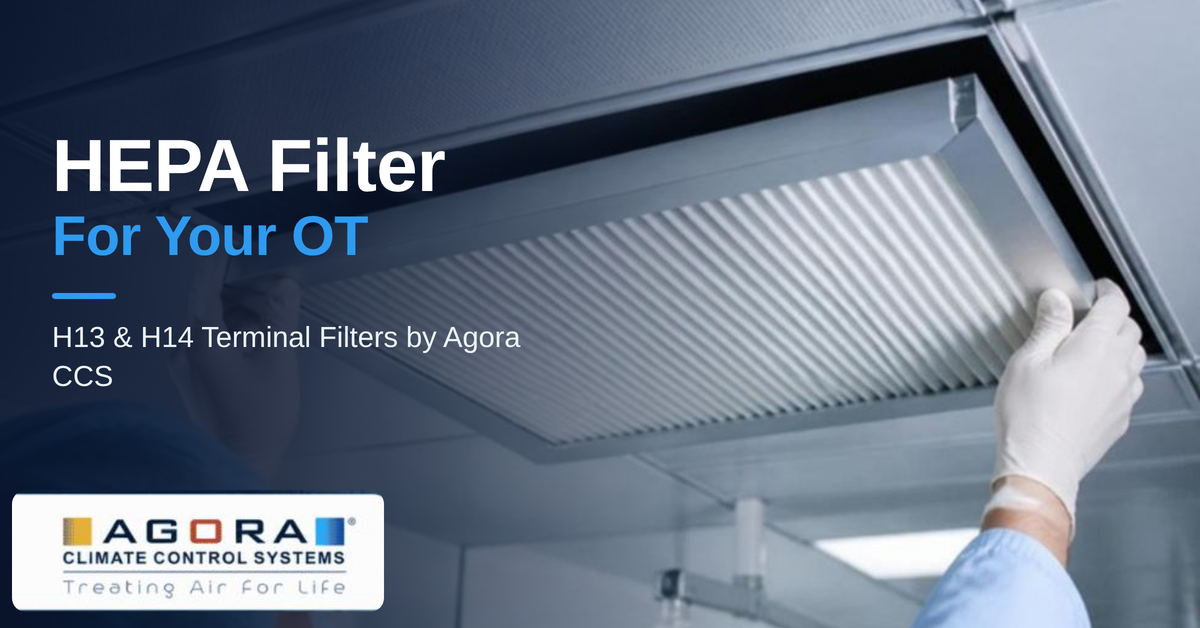
Operation theatres use terminal HEPA filters in the ceiling rated at least 99.97% at 0.3 µm, the NABH minimum, which corresponds to EN 1822 class H13. Type A theatres for implants, neurosurgery, cardiac and transplant surgery normally use H14 filters rated 99.995% at the MPPS.
Q2. Is H13 or H14 better for an OT?
H14 is the safer choice for Type A theatres, because it lets through ten times fewer test particles than H13. However, H13 meets the NABH minimum and suits Type B general theatres. The cost and pressure-drop differences between the two grades are small relative to the theatre.
Q3. How often should the HEPA filter in an OT be changed?
Replace it when pressure drop reaches the manufacturer’s final resistance, when it fails the six-monthly leak test and cannot be repaired, or when it has been wetted or damaged. With pre-filters washed every 30 days, a terminal HEPA in an Indian OT typically lasts two to four years.
Q4. What is the DOP or PAO test for HEPA filters?
It is the installed filter leak test defined in ISO 14644-3. A PAO aerosol is injected upstream at a known concentration, and a photometer scans the downstream face, gasket and frame. Any point above 0.01% of the upstream concentration is a leak. NABH requires it every six months.