What Does an Indoor Air Quality Specialist Actually Do?
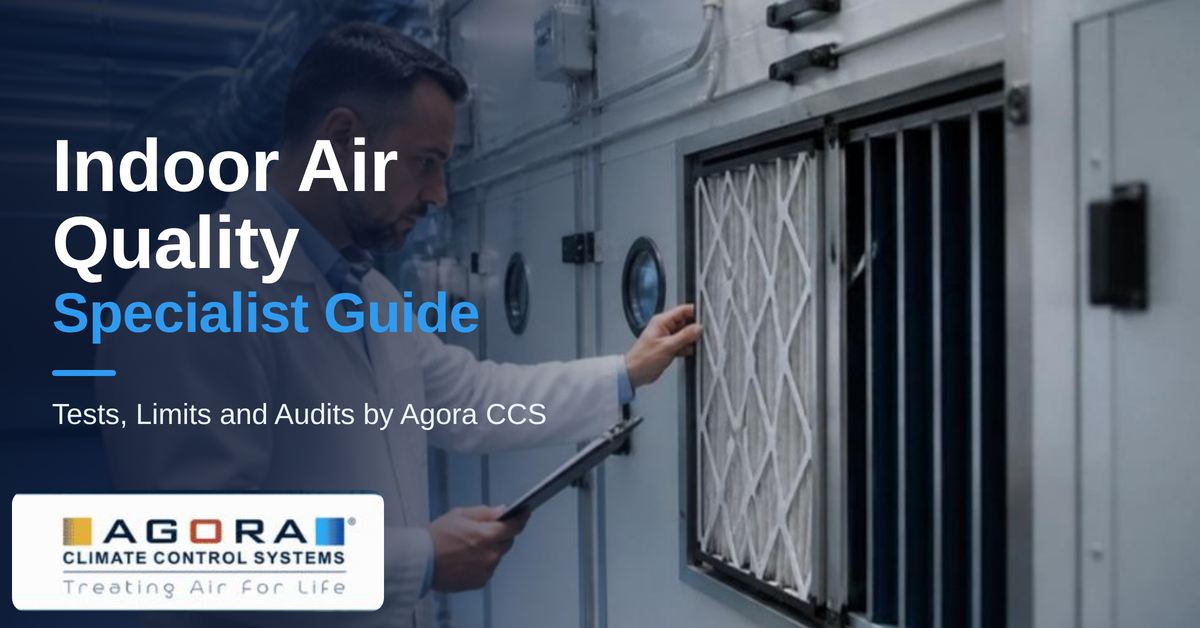
An indoor air quality specialist measures what the air inside your building does to the people breathing it. Particles, CO2, VOCs, humidity, microbial counts, pressure and ventilation rate — every reading is compared with the limit for that specific room.
In India the problem has a local shape. Sealed air-conditioned buildings, outdoor PM2.5 far above WHO limits, a monsoon that keeps AHU coils damp for months, and diesel generators parked next to fresh-air intakes all push indoor readings out of range.
Why Indoor Air Quality Matters More in a Hospital
People spend around 90% of their time indoors, and the US EPA estimates some pollutants run two to five times higher inside than out. In a hospital, the stakes are higher because air is an infection route. WHO’s 2022 report found that 15 of every 100 acute-care patients in low- and middle-income countries acquire an infection during their stay.
Spot readings mislead, because CO2 peaks at 3 pm and humidity peaks at dawn. So an indoor air quality specialist logs rooms for 24–72 hours, tests critical areas both at rest and in operation, and reports every reading against its limit. The report also names the likely cause of each failure.
Limits an Indoor Air Quality Specialist Works To
These are the key figures a proper IAQ report in India must test against:
- PM2.5 — the WHO 2021 guideline is 15 µg/m³ over 24 hours. In fact, India’s outdoor NAAQS allows 60, so merely matching outdoor air is not clean.
- CO2 — under 1,000 ppm in occupied rooms per ASHRAE 62.1 and ISHRAE. Readings above 1,500 ppm usually mean a closed fresh-air damper.
- Operation theatres — at least 20 air changes per hour (4 fresh), +2.5 Pa positive pressure and 21 ± 3 °C under NABH 2018.
- Humidity — 40–60% in general spaces and 20–60% in OTs, with 55% ideal, because mould grows above 60%.
- Particle counts — ISO 5 allows ≤3,520 and ISO 7 allows ≤352,000 particles at 0.5 µm per m³ under ISO 14644-1.
The particulate limits trace back to the WHO air quality guidelines.
Notice that the critical-room limits are about airflow and pressure, not just concentration, so a purifier cannot meet them. That is why our hospital HVAC, ICU HVAC and cleanrooms projects start with a pressure map, not a tonnage calculation. The same engineering lets us correct a failed reading, not just report it.
Why Hospitals Trust Agora CCS
Agora Climate Control Systems has measured, designed and built controlled environments for over 16 years from our factory in Vasai, near Mumbai. With a 78-member team, 500+ hospital projects, ISO 9001:2015 certification and our own AHUs, laminar airflow units and HEPA modules, we test to NABH, ASHRAE 170 and ISO 14644 — and when a reading fails, we design and carry out the correction ourselves.
Visit: https://agoraccs.com/ | Free Consultation | Pan India Delivery
Frequently Asked Questions (FAQ)
Q1. What does an indoor air quality specialist do?
They measure particles, CO2, VOCs, humidity, temperature, microbial counts, pressure and ventilation rates, then compare the readings with the limits for each room (WHO, NABH, ISO 14644, ASHRAE). They also identify the cause of any failure and correct the ventilation, filtration or moisture control so the space passes.
Q2. What is a safe CO2 level indoors?
Outdoor air is about 420 ppm. ASHRAE 62.1 and ISHRAE treat 1,000 ppm as the practical ceiling for an occupied room. Above that, fresh-air supply is inadequate, and readings over 1,500 ppm usually mean a fresh-air damper has been closed to save power.
Q3. How is indoor air quality tested?
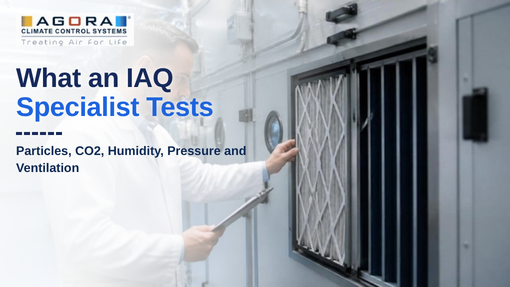
With calibrated instruments logged over 24–72 hours, not spot readings: a laser particle counter, CO2 and VOC sensors, humidity loggers, a balometer for air changes, a manometer for pressure, an active air sampler for microbes and a PAO photometer for HEPA leaks. Critical rooms are tested at rest and in operation.
Q4. Can an air purifier fix hospital air quality?
A portable HEPA purifier can lower particle counts in a waiting area. However, it cannot create positive or negative pressure, deliver 20 air changes per hour, control humidity or provide laminar flow. OTs, ICUs and isolation rooms need engineered ventilation with HEPA filtration built into the air-handling system.