How Does Laminar Airflow Actually Work?
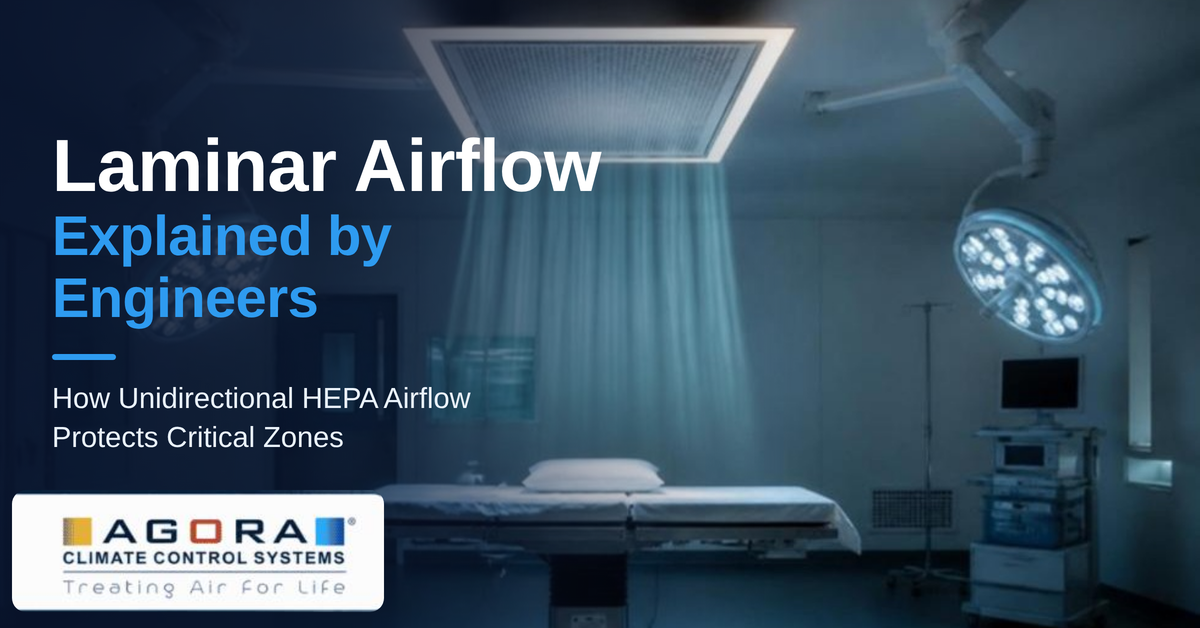
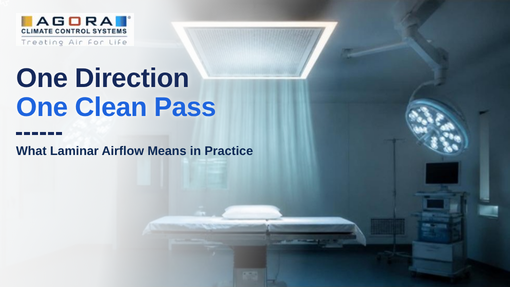
Laminar airflow is HEPA-filtered air moving in parallel streams, at one speed, in one direction. Instead of mixing with room air, it sweeps particles out of a protected zone in a single pass. That is why engineers also call it unidirectional airflow.
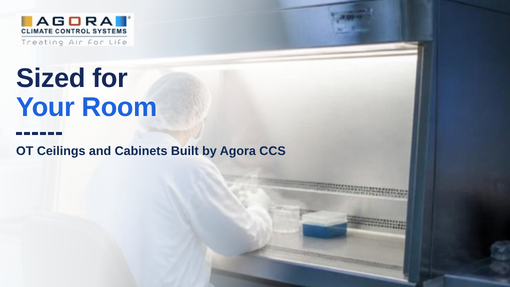
The same two words describe an OT ceiling and a bench-top lab cabinet. The physics is identical; however, the numbers are not. Most of the confusion we hear in meetings comes from mixing them up.
Why Laminar Airflow Matters in Critical Zones
Conventional ventilation dilutes contamination. Clean air enters, mixes with room air, and the average slowly improves. Unidirectional flow works differently: the air acts like a slow piston. So a skin flake or droplet released inside the zone is carried out in one pass, never recirculated over the patient or the product.
EU GMP Annex 1 (2022) calls this “first air” — filtered air that reaches a critical surface without touching anything else first. That phrase captures the whole purpose. In an OT, the protected zone is the wound and the instrument trolley; in a pharma plant, it is an open vial or a filling needle.
Laminar Airflow Numbers That Define the System
Every standard specifies a velocity range, because air that is too slow breaks up before it reaches the work. Air that is too fast rebounds off the table and creates edge turbulence.
- OT face velocity — 25–35 fpm (0.13–0.18 m/s) from a non-aspirating diffuser, per NABH 2018.
- Pharma Grade A velocity — 0.36–0.54 m/s at the working position, per EU GMP Annex 1 (2022).
- HEPA grade — H13 (99.95%) minimum; H14 (99.995%) for Type A theatres and Grade A zones.
- Air cleanliness — ISO Class 5 at rest in a Type A OT; ISO Class 6 in a Type B theatre.
- Surrounding room — a minimum of 20 air changes per hour around the clean column, 4 of them fresh, at +2.5 Pa positive pressure.
The particle classes above are defined in the ISO 14644-1 standard.
If the system is going into a theatre, start with our guide to modular OT in India. For a plant, see pharma cleanroom manufacturing. And before you budget, the drivers behind ceiling pricing are explained on our cost of laminar air flow page.

Why Hospitals Trust Agora CCS
Agora Climate Control Systems has manufactured these ceilings and cabinets for over 16 years at our factory in Vasai, near Mumbai, and installs them across India. Every unit ships with H14 filters, a velocity and particle-count report, and IQ/OQ/PQ documents. Moreover, we build the ceiling, the terminal HEPA filters, the plenum and the diffuser as one module to NABH 2018 and DIN 1946-4, and we fit the test ports needed to prove the velocity every six months.
Visit: https://agoraccs.com/ | Free Consultation | Pan India Delivery
Frequently Asked Questions (FAQ)
Q1. What is the difference between laminar and turbulent airflow?
Turbulent, mixed ventilation dilutes contamination by blending clean supply air with room air, so particles keep circulating. Unidirectional flow displaces it instead: the air moves as a slow piston and carries particles out in one direction. Turbulent ventilation suits wards and corridors; critical zones need unidirectional flow.
Q2. What velocity should laminar airflow have?
It depends on the application. NABH 2018 recommends 25–35 feet per minute (0.13–0.18 m/s) at the diffuser face in an operation theatre, low enough for surgical comfort. However, EU GMP Annex 1 requires 0.36–0.54 m/s in pharma Grade A zones and clean benches. Uniformity across the filter face matters as much as the number.
Q3. Is laminar airflow mandatory in an operation theatre?
NABH 2018 requires unidirectional, downward airflow over the OT table from a non-aspirating diffuser or ceiling array. The filtered area must extend one foot beyond the table on all sides, for both Type A and Type B theatres. A modular OT itself is not mandatory; in the end, the airflow performance is what is assessed.
Q4. How much does a laminar airflow system cost in India?
Bench-top and cabinet units range from about ₹45,000 for a two-foot horizontal clean bench to around ₹2,00,000 for a six-foot vertical unit with H14 filters. An OT ceiling is priced per project, because it is sized to the table, the theatre type and the AHU behind it.